

Exhibition“MOOMIN PEACE. Joy and Wisdom”
in the Kiek in de Kök tower
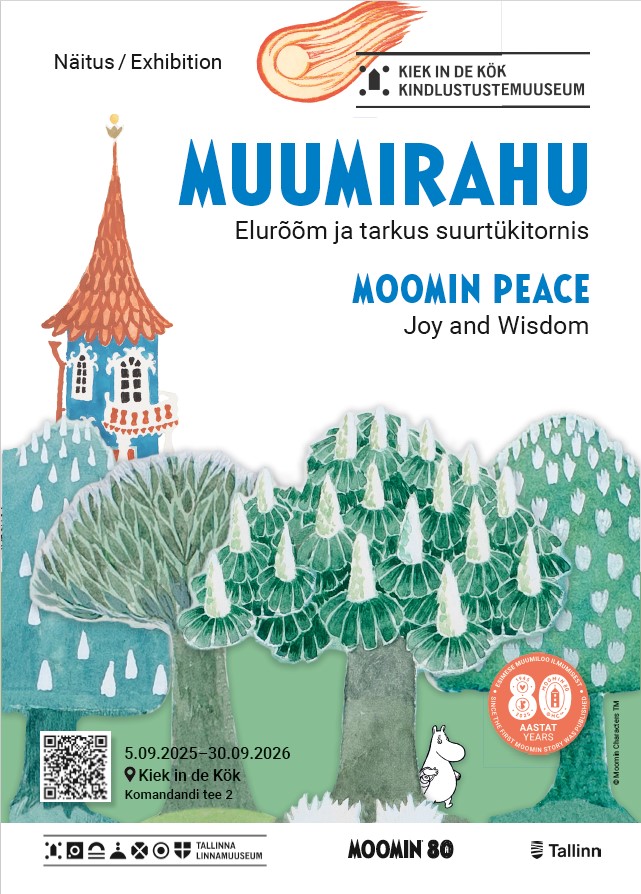
The exhibition invites visitors of all ages to explore Moomin House and Moomin Valley, where – like the Kiek in de Kök artillery tower – peace and a sense of security prevail despite the turmoil of the outside world.
In this small yet meaningful exhibition, you can stroll beneath blooming trees, sit among rose beds and meet your favourite characters amid lush greenery. At the heart of it all, the Moomin House offers shelter and beauty for everyone, even the smallest nameless creatures. Hiding within its walls, you might discover a hidden, sparkling secret. Although mysterious and sometimes unsettling creatures like the Groke and the Hattifatteners roam around Moomin Valley, the valley itself remains a place of peace and tranquillity, allowing visitors to relax for a moment. Hopefully, the comet will pass by without disrupting the valley’s peacefulness. Both the Moomin House and the Kiek in de Kök artillery tower serve as sanctuaries of peace.
When Tove Jansson began writing her first Moomin book in the early winter of 1939, the threat of war hung heavy in the air. The story that she wrote had a bleak beginning, but a happy ending: the discovery of a paradise. The lost father of the Moomin family is rescued, and the characters arrive in a valley in bloom that is “more beautiful than anything”. The sky-blue Moominhouse comes to view on the riverbank. “Why, that’s my house!” cried Moominpappa, quite beside himself with joy. “It must have floated here, and here it is!” Tove Jansson drew inspiration for the tower-like shape of the Moominhouse from the Glosholm daymark (a former lighthouse) in the Gulf of Finland, which she had been visiting ever since her childhood.
Now the Moominhouse has drifted all the way to the tower of Kiek in de Kök in Tallinn’s Old Town. Kiek in de Kök’s shape is reminiscent of Moominhouse, although it is also its opposite. Where Moominhouse is lively, informal, and open to all, the stone tower of Kiek in de Kök was built for defence and to ward off danger from the outside. In this time of threats that we now live in, it is a symbol of defending peace, beauty, and the joy of living, so that all kinds of creatures can get along together.
The exhibition installation also highlights the contrasts within the world of the Moomins.
A comet blazes across the sky over the valley, and sometimes the Moominvalley is wracked by floods and storms. There are also some strange characters that may even be a bit scary. However, adventure is a key part of the Moomin works, and the sunny meadow of flowers seems to shine all the brighter as the stormy sky darkens with thunder behind it. Tove Jansson’s Moomin works are not based on the battle between good and evil, but on the coexistence of different personalities and the tension and humour that arise from it. In the Moominvalley, you can both be kind to others and be yourself. The Moomins always have time for a dance, and their everyday life is never boring. At the heart of the exhibition’s Moominhouse glows the King’s Ruby, in whose flames the Moomin family sees “the most beautiful, the most daring, and the most exquisite of all that they longed to imagine and experience once more”.
Come rest your feet and your mind in the garden of the Moominvalley! You can hear the “voices” of the Moominhouse by reading quotes from the Moomin books and comics on its walls.
Curator: Sirke Happonen.
Designer: Alexander Reichstein.
Open from 5 September 2025 – 30 September 2026.
NB! Due to the Rescue Board’s injunction, the Moomin Exhibition and the upper floors of the Kiek in de Kök tower are not open on free Sundays.
